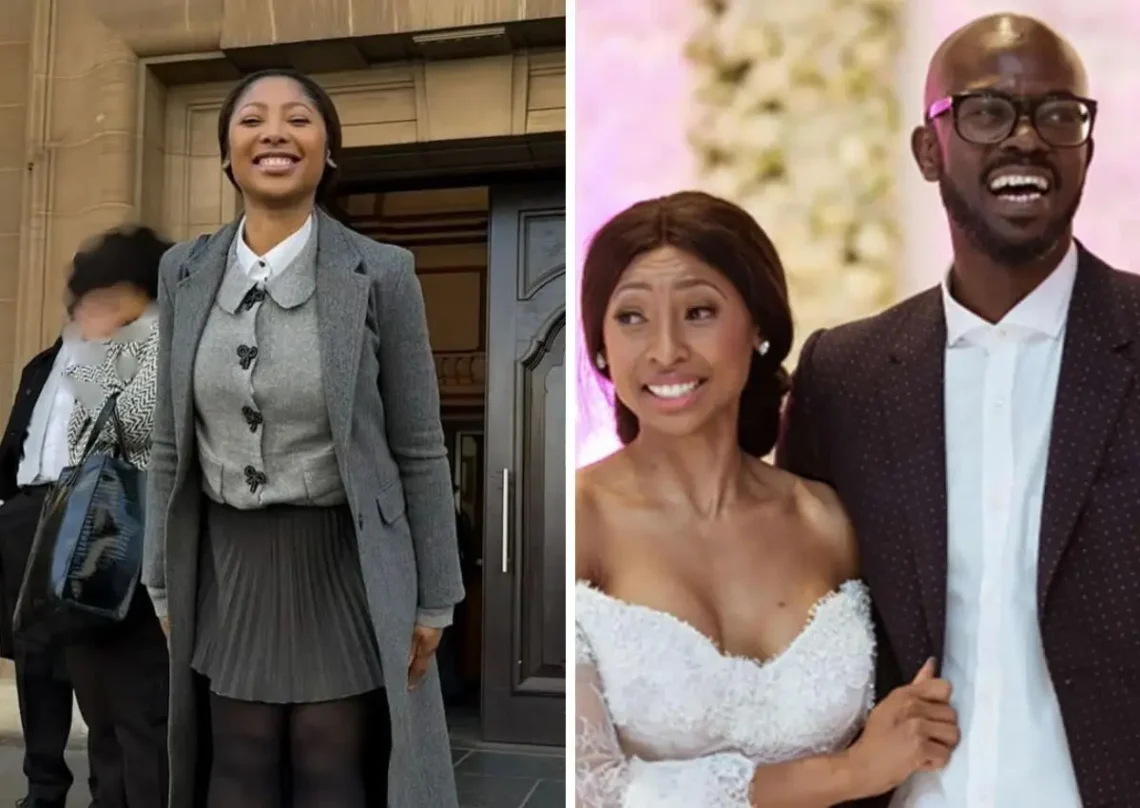
Seven Years, One Customary Truth: Enhle Mbali Mlotshwa’s Landmark Divorce Victory Against DJ Black Coffee
The Weight of an African Vow (Meta Hook)
For years, the highly publicized separation of South African actress Enhle Mbali Mlotshwa and world-renowned DJ Black Coffee (Nkosinathi Maphumulo) was more than just a celebrity divorce; it was a complex legal and cultural battle that captivated Mzansi and beyond. The core dispute was fundamental: the validity of their customary marriage under South African law. After an agonizing seven-year legal battle, Mlotshwa announced her definitive divorce court victory, a moment that serves not only as a personal triumph but as a landmark for women’s rights in Africa.
This victory confirmed that their union was valid and, crucially, in community of property, effectively invalidating a later antenuptial contract. This blog explores the complex legal issues, the cultural implications, and the sheer fortitude displayed by Enhle Mbali Mlotshwa in her fight to prove her truth and secure her future. Her story is a powerful reminder that sometimes, the most profound victories are those that redefine the law for all.
Customary Marriage vs. Contractual Law
The heart of the legal battle lay in the distinct nature of South African marriage law, which recognizes both civil and customary unions. In 2011, Enhle Mbali Mlotshwa and DJ Black Coffee (Nkosinathi Maphumulo) had a traditional wedding ceremony, complete with the payment of lobola and the traditional rituals that finalize a customary marriage.
According to the Recognition of Customary Marriages Act (1998), if a customary marriage is validly concluded, it is automatically deemed to be in community of property—meaning the assets and debts of both spouses are equally shared—unless the couple had signed an antenuptial contract before the traditional ceremony commenced.
The problem arose when the couple later held a spectacular white wedding in 2017, for which an antenuptial contract (ANC) was allegedly signed. The legal argument deployed against Mlotshwa was that the customary marriage was either incomplete or that the ANC, signed closer to the white wedding, governed the estate, thereby keeping the massive wealth accumulated by DJ Black Coffee separate.
To combat this, Mlotshwa had to undertake the extraordinary, and deeply frustrating, process of proving the legal and cultural authenticity of her 2011 union. She was forced to present evidence, witnesses, and cultural interpretations in court to confirm that the traditional rituals—the lobola negotiations, the handing over of the bride, and the subsequent celebrations—met all the necessary requirements of a customary marriage under South African law. The very fact that a woman had to fight so fiercely to validate a publicly celebrated traditional union underscores the vulnerability often faced by women in such hybrid legal situations.
Emotional and Public Scrutiny
The duration and public nature of this legal battle were unprecedented, turning Mlotshwa’s divorce into a national spectacle. The process was not confined to courtroom documents; it spilled into the media and social platforms, amplifying the emotional cost.
Reports detailing the initial financial demands made by Enhle Mbali Mlotshwa, though often sensationalized, demonstrated the financial disparity that frequently defines high-profile celebrity divorce cases. While a 2020 ruling ordered a specific maintenance amount, the larger legal battle over the property regime continued to rage. Furthermore, the proceedings were overshadowed by allegations of emotional and physical abuse raised by Mlotshwa against her estranged husband, claims he consistently denied, further complicating the public narrative and adding immense pressure to Mlotshwa.
Mlotshwa’s resolve during this period became her defining feature. Her candid remarks, such as questioning the absurdity of having to “go to court to prove that I was married to him traditionally,” resonated deeply with many women across Mzansi who understand the often-unequal power dynamics in relationships and legal fights. She transformed her vulnerability into a platform for advocacy, setting the stage for her ultimate vindication.
A Definitive Victory for Enhle Mbali
The final ruling by the Johannesburg High Court was a clean sweep for Enhle Mbali Mlotshwa and a clear affirmation of the strength of South African law regarding customary unions. The key decisions delivered a powerful message:
4.1. Primacy of the Customary Marriage
The court ruled that the 2011 traditional ceremony was a valid customary marriage. This decision acknowledged that all the necessary traditional and cultural requirements had been met, giving the union legal standing from that date forward.
4.2. Invalidation of the Antenuptial Contract
Perhaps the most crucial aspect of the divorce court victory was the invalidation of the later antenuptial contract. The court found that the ANC could not retrospectively negate the existing legal status of the customary marriage. Furthermore, reports suggested the court found Mlotshwa was misled and lacked proper legal counsel when signing the contract. The pre-existing customary marriage automatically established the in community of property regime, which takes precedence.
4.3. The Power of “In Community of Property”
By declaring the marriage in community of property, the court ensured that Mlotshwa is entitled to a fair and equal division of the joint estate. For a woman who was married to a global music icon like DJ Black Coffee (Nkosinathi Maphumulo) during his period of massive international success and wealth accumulation, this ruling is the financial security and justice she fought for. It shifts the entire dynamic of the settlement, moving it from a maintenance issue to a partnership division.
A Landmark for African Women’s Rights
The magnitude of Mlotshwa’s divorce court victory extends far beyond the lives of the two famous individuals. This case provides a critical landmark for women’s rights in South Africa and, by extension, other African nations where dual legal systems (civil and customary) are common.
This judgment serves as a robust defense against attempts to use post-ceremony contracts to undermine the financial rights of women in traditional marriages. It reinforces the principle that cultural practices recognized by the state must be treated with respect and cannot be easily manipulated for financial gain by the wealthier party. The court has essentially affirmed that a woman’s contribution to a traditional home and partnership, even one that is not financially equal, is recognized and protected by the full force of the law when the marriage dissolves. This level of legal clarity helps protect vulnerable spouses who may not have equal bargaining power or access to independent legal counsel during the marriage planning process. It is a powerful message of empowerment for women who choose the customary path.
The Next Chapter: Reclaiming Miss Mlotshwa
In her statement, Enhle Mbali Mlotshwa captured the essence of her liberation with four simple words: “I am officially Miss Mlotshwa.” This declaration signals a definitive closure to the seven-year legal battle and a powerful step into a new chapter of independence, free from the shadow of the celebrity divorce.
Her journey, while “ugly,” has yielded profound public and personal lessons. She demonstrated remarkable perseverance, turning a deeply personal trauma into a public service by highlighting and challenging legal ambiguities that often disadvantage women.
The divorce court victory against DJ Black Coffee is a powerful affirmation of her strength, her truth, and the legal recognition of her African heritage. As she moves forward, Enhle Mbali Mlotshwa steps into her power not just as a successful actress and entrepreneur, but as a warrior who fought for her rights and, in doing so, cleared the path for many others. Her story will be referenced for years as a testament to the fact that cultural tradition and modern South African law can and must align to ensure justice and equality for all spouses, regardless of wealth or fame.
Disclaimer: This article is based on publicly available court reports and statements made by the parties and their legal representatives. It is intended for informational and commentary purposes only and does not constitute legal advice. Individuals facing divorce or family law matters in South Africa should consult with a qualified legal professional.


You May Also Like

Breaking the Mold: Challenging Gender Stereotypes and Embracing Authenticity

Reporting from the Front Lines: The Unique Challenges and Triumphs of Female War Correspondents and Investigative Journalists