USA Continue Dominance With 12th FIBA Women’s Basketball World Cup Title
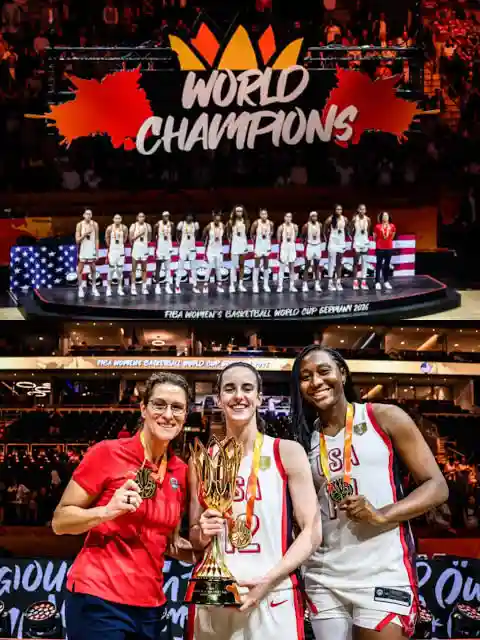
The United States women’s basketball team has added another chapter to its remarkable international legacy, defeating France 97-79 in Berlin to capture the 2026 FIBA Women’s Basketball World Cup title.
The victory gave the USA its 12th Women’s Basketball World Cup championship and its fifth consecutive title, extending one of the most dominant runs in international basketball. The Americans overcame a 14-point deficit in the first half before taking control after halftime and pulling away from France in front of 12,223 fans at the Berlin Arena.
The result also extended the United States’ extraordinary World Cup winning streak. The Americans have now won 36 consecutive World Cup games, with their most recent defeat coming against Russia in the 2006 semifinals. Since then, the USA has remained unbeaten in the competition and has continued to set the standard for women’s basketball around the world.
USA Overcomes Early Trouble Against France
The final did not begin the way the United States expected.
France came out aggressively and quickly put pressure on the defending champions. The French team produced a 21-2 scoring run and built a 14-point advantage during the first half, creating the possibility of one of the biggest upsets in recent Women’s Basketball World Cup history.
Rather than allowing the deficit to define the game, however, the USA gradually fought its way back.
The Americans reduced France’s advantage to just two points by halftime, giving them a completely different outlook heading into the second half. Caitlin Clark provided an important moment during the comeback with a three-pointer that helped the USA close the gap before the break.
The second half became a showcase of the experience, depth and composure that have helped make the United States so difficult to beat on the international stage.
Breanna Stewart Leads the Championship Comeback
Breanna Stewart played a central role in the USA’s comeback and delivered one of the most important performances of the tournament.
Stewart finished the championship game with 22 points, 10 rebounds and four assists, helping the United States recover from its difficult start and take control of the final. Her production came at crucial moments as the Americans turned the game around.
Her performance was also significant on an individual level.
Stewart was named the tournament’s Most Valuable Player, becoming the first player in FIBA Women’s Basketball World Cup history to win the award twice. Her latest MVP honor adds another achievement to an already decorated international career.
The veteran forward’s ability to remain composed while France controlled the opening stages became one of the defining stories of the final.
Instead of forcing the game, the USA continued to play through its system and waited for opportunities to shift the momentum.
The Third Quarter Changed Everything
The biggest turning point came after halftime.
The United States produced a dominant third quarter, outscoring France 30-12 and transforming a close game into one that increasingly favored the defending champions. Back-to-back three-pointers from Kahleah Copper and Jackie Young helped ignite the American attack as the team began creating separation.
The USA’s defense also became more effective as the game progressed.
France had been able to generate momentum during the opening half, but the Americans made it increasingly difficult for the French offense to maintain the same rhythm. Once the USA established control, France struggled to regain the momentum it had created early in the game.
By the beginning of the fourth quarter, the Americans had built a lead of 19 points.
At that stage, the championship was firmly within reach.
Jackie Young Provides Another Major Contribution
While Stewart was the centerpiece of the comeback, Jackie Young also played an important role in the championship performance.
Young scored 18 points while contributing across the court, giving the United States another reliable offensive option as France attempted to contain Stewart.
The balance of the American roster was once again evident.
Rather than depending on one player to carry the offense, the USA could turn to multiple veterans and emerging stars throughout the game. That depth has become one of the defining characteristics of the American program.
Kahleah Copper also provided valuable scoring during the comeback, while Chelsea Gray and other experienced players helped the USA maintain control as France attempted to respond.
France Falls Short in Its First World Cup Final
For France, the silver medal represents a major achievement despite the disappointment of losing the championship game.
The French team reached its first-ever Women’s Basketball World Cup final and entered the matchup with confidence after a strong tournament run. France defeated host nation Germany 86-64 in the semifinals to earn its place in the championship game against the world’s No. 1-ranked team.
France also showed during the final that it could challenge the United States.
The team’s early 14-point advantage demonstrated that the gap between the American program and the rest of the world is not impossible to close. Gabby Williams and Dominique Malonga led France’s offense, with Williams scoring 20 points and Malonga adding 21.
But maintaining that level against the USA for an entire game proved to be a different challenge.
After the Americans adjusted defensively and began finding more consistent offensive opportunities, France could not regain control.
A Historic Fifth Consecutive World Cup Championship
The 2026 championship is the fifth consecutive FIBA Women’s Basketball World Cup title for the United States.
The run includes championships in 2010, 2014, 2018, 2022 and now 2026. The latest victory further extends the USA’s record total of World Cup championships to 12.
The achievement is especially remarkable because the American program has remained dominant across multiple generations of players.
Different rosters have come and gone, but the overall standard has remained remarkably consistent. Veterans have continued to provide leadership while younger players have entered the program and contributed to the team’s success.
That ability to maintain excellence through roster changes is one of the reasons the United States remains the benchmark in women’s international basketball.
USA’s International Winning Streak Continues
The latest World Cup championship is part of an even larger streak for the American women’s national team.
The USA has not lost a game in major international competition since 2006, according to ESPN, and has lost only one Women’s Basketball World Cup gold-medal game in its history.
The Americans also entered the 2026 final having won 35 straight World Cup games. The victory over France pushed that streak to 36.
That level of consistency is extremely difficult to maintain in international basketball because teams have to adjust to different styles of play, opponents and tournament circumstances.
The 2026 final demonstrated that challenge clearly.
France was able to exploit the USA early, but the Americans made adjustments and ultimately found a way to win.
Caitlin Clark Adds to a Deep American Roster
The 2026 team also attracted significant attention because of the presence of Caitlin Clark.
Clark’s participation added another major name to an already talented roster and brought additional attention to the Women’s Basketball World Cup. She contributed 12 points in the final, although she also committed four turnovers and received a technical foul.
Her presence was part of a larger transition taking place within the American program.
The USA continues to combine established international stars with younger players who represent the next generation of women’s basketball.
That mixture gives the team an unusual level of depth.
Players such as Aliyah Boston, Angel Reese, Rhyne Howard and Clark represent a younger generation capable of helping carry the program forward, while experienced players such as Stewart, Gray and Copper provide championship-level leadership.
The Global Competition Is Getting Stronger
Although the United States remains the dominant force, the 2026 tournament also demonstrated that international women’s basketball continues to become more competitive.
France’s strong start in the final was one example.
Spain also reached the semifinals before losing to the United States 76-66. France defeated Germany 86-64 in the other semifinal, while Spain later claimed the bronze medal with an 81-58 victory over host nation Germany.
The fact that several teams were able to challenge established powers throughout the tournament shows the continued growth of women’s basketball internationally.
For the USA, that makes the achievement even more impressive.
Winning is one thing. Maintaining that level of success while the rest of the world improves is another.
Spain Takes the Bronze Medal
Spain completed the Women’s Basketball World Cup podium with a bronze-medal victory over Germany.
The Spanish team had fallen to the United States in the semifinals but bounced back in the third-place game, defeating the tournament hosts 81-58.
Germany’s run to the semifinals was still an important result for the host nation, giving the home crowd another reason to celebrate during the tournament.
The final standings also highlighted the growing depth of women’s basketball in Europe and beyond.
What the USA’s Victory Means for Women’s Basketball
The United States’ latest championship is about more than another trophy.
It reinforces the country’s position at the top of women’s international basketball while providing another showcase for the talent and competitiveness of the women’s game.
The tournament also gave younger players an opportunity to compete against some of the world’s best athletes on one of the sport’s biggest stages.
For fans, the final offered a reminder of why the Women’s Basketball World Cup continues to attract global attention.
France’s early dominance, the USA’s comeback and Stewart’s MVP performance created a championship game that had both drama and historical significance.
Breanna Stewart Adds Another Chapter to Her Legacy
Stewart’s second World Cup MVP award further strengthens her place among the greatest players in women’s international basketball.
Her performance in Berlin was not simply about scoring.
She provided rebounding, playmaking, leadership and composure when the USA needed to overcome a significant deficit. Her ability to influence the game in multiple areas was critical to the comeback.
By becoming the first two-time Women’s Basketball World Cup MVP, Stewart also created a piece of history that could remain unmatched for years.
Her success illustrates how the USA’s dominance has been built not only on talent but also on players capable of delivering when championship pressure is at its highest.
USA Looks Ahead After Another World Cup Triumph
The 2026 FIBA Women’s Basketball World Cup may be over, but the American women’s basketball program shows little indication of slowing down.
The next major international challenge will eventually bring another generation of players into the spotlight, and the USA will enter future competitions with the pressure that comes from being the reigning champion.
The rest of the world will be looking for ways to close the gap.
France provided one of the clearest examples in Berlin. Its ability to build an early lead showed that the USA can be challenged. The difference was the Americans’ ability to respond when the game became difficult.
That resilience remains one of the team’s defining qualities.
USA Remains the Standard in Women’s Basketball
The United States entered the 2026 FIBA Women’s Basketball World Cup as the defending champion and left Berlin with another trophy.
The 97-79 victory over France delivered the USA’s 12th World Cup championship, its fifth consecutive title and its 36th straight World Cup victory.
The final also demonstrated why the American team has remained so dominant for so long.
France produced an impressive challenge and led by as many as 14 points, but the USA responded with championship-level basketball. Stewart led the comeback, Young provided crucial scoring and the American defense eventually took control.
For France, reaching its first World Cup final was a significant achievement. For Spain, the bronze medal added another strong result. And for the United States, the tournament ended with another gold medal and another piece of basketball history.
The dynasty continues.
With 12 Women’s Basketball World Cup titles and five consecutive championships, Team USA once again proved that it remains the gold standard of women’s international basketball.
Citation Section
- FIBA: USA Continue Dominance With 12th FIBA Women’s Basketball World Cup Title
- FIBA: USA vs France Final Box Score and Game Information
- Reuters: USA Overcome 14-Point Deficit, Beat France 97-79 to Win Women’s World Cup
- ESPN: How Team USA Rallied to Beat France and Win World Cup Gold
- Olympics.com: FIBA Women’s Basketball World Cup 2026 and USA’s Historic Fifth Championship


You May Also Like
Women’s Equality Day: Honoring the Past and Shaping a More Equal Future
Empowered Women, Empower Women: The Unstoppable Journey of Self-Discovery and Strength